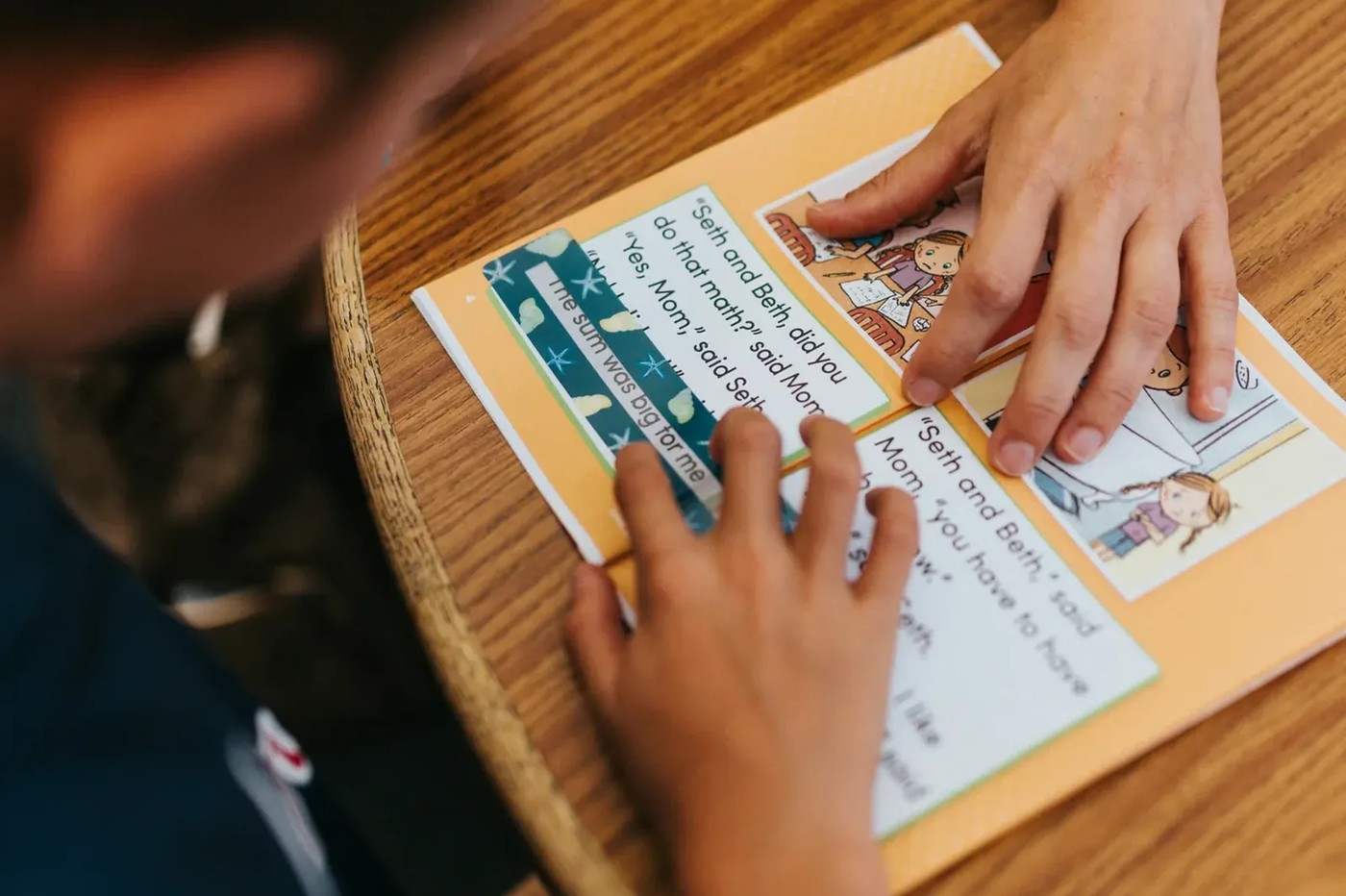
A social story is a short, personal story that explains a situation to a child: what usually happens, who will be there, and why. It is written for one child, in words and pictures that make sense to them, and read together at a calm time, often just before the situation. A good social story shares information and helps a child prepare. It isn’t a list of rules, and it isn’t a way to make a child seem less autistic.
This guide covers where social stories come from, what the research says, and how to write one with your child. For picture-based routines, see our guide to visual schedules at home.
What is a social story?
The Raising Children Network describes social stories as stories that explain social situations to autistic children. They point out details that are easy to miss: what the setting is like, what usually happens there, and what people usually do. They can also explain what other people might be thinking or feeling, and help a child cope with changes or unexpected events.
A story might be about:
- a new or busy place, such as the supermarket or the playground;
- a change in routine, such as a new teacher;
- something that happens now and then, such as a haircut or a dentist visit;
- something your child did well, written to celebrate it.
Raising Children notes they are also sometimes used with children with learning difficulties or intellectual disability, and may be less effective for children who find it hard to understand them. A story can be a printed book or an ebook, with photos or drawings. If your child isn’t reading yet, you can read it to them, or record it so they can listen while they follow along.
Social Stories™ and Carol Gray’s criteria
Carol Gray began working with autistic students as a teacher in Michigan in the United States in 1976, and developed Social Stories in 1990. Social Story™ and Social Stories™ are trademarks owned by Carol Gray. On her website, she separates genuine Social Stories, which meet a defined set of criteria, from social scripts, skill checklists and other “social stories” that don’t. Her approach is for autistic people of all ages, with longer Social Articles for older readers.
In this article, “social story” in lower case means the general idea. Gray’s version is defined by 10 criteria, most recently updated as Social Stories 10.4 in 2023. In plain terms, they ask the writer to:
- Gather information first, including from parents and, where possible, the child, and decide whether a story is the right tool or whether something else would help more.
- Give it a title, a beginning, a middle and an end.
- Tailor it to the child’s attention span, understanding and, where possible, interests.
- Write in the first or third person (“I” or the child’s name), never “you”, with a patient, positive and accurate tone.
- Answer the questions that matter: where, when, who, what, how and why.
- Describe far more than direct. Descriptive sentences must outnumber “coaching” sentences, which gently suggest a response, by at least 4 to 1. No more than one sentence may coach the child.
- Celebrate. At least half of the stories written for a child should praise what they are doing well.
- Introduce it with care and check that it still helps.
Gray’s screening checklist adds that a Social Story leaves out words like “should”, “must”, “naughty” and “inappropriate”. It is never read as a consequence for behaviour, and it never replaces supervision, for example when crossing a road.
Many stories shared online as social stories don’t follow these criteria. Raising Children notes that parents, as well as professionals, can use the criteria to write their own stories. If a professional offers Social Stories™, it’s fair to ask how they use them.
Do social stories work?
They can help with specific situations, but the evidence is limited.
Raising Children says research shows social stories can have positive effects for autistic children, including on behaviour and skill development. Most studies are small, so more research is needed, and stories need to be tailored to the child and used at the right time.
Reviews of the research show the same limits:
- A 2006 review by researchers at Macquarie University found the effects were “highly variable”. It still called social stories a promising approach that is fairly simple to use.
- A 2010 analysis of single-case studies rated their overall effectiveness as “low to questionable”. Stories did better when they addressed a particular behaviour than when they were used to teach social skills.
- A 2016 UK review found that most studies used single-case designs, mostly with children under 12 in the United States. Most didn’t follow Gray’s criteria, or didn’t say whether they did.
The largest trial so far, ASSSIST2, was published in 2024. It included 249 autistic children aged 4 to 11 in 87 primary schools in England. After 6 months, there was no clear change in general social skills, anxiety or depression, parent stress or general health. Children with stories did meet their own individual goals more often than children who had usual support. The researchers suggested social stories may be a useful way for children and school staff to talk about a specific situation. The trial was disrupted by COVID-19, which adds some uncertainty.
So a social story is a low-cost tool that may help with one clear, personal goal, such as knowing what happens at a new place. It is unlikely, on its own, to change broader social skills. For the wider evidence on OT and autism, see is occupational therapy a legitimate autism intervention?
Stories that explain, not demand
Much early research used social stories to reduce behaviours other people saw as a problem. In a 2023 paper, researchers at the University of Bath argued that labelling autistic behaviour as “inappropriate” comes from a deficit view of autism. They suggested using stories as Gray intended: to share accurate information, or to support changes the autistic person wants to make themselves.
Gray’s criteria rest on what she calls social humility: each person’s view of a situation is valid, and misunderstandings go both ways. That fits a neuro-affirming approach. A story can explain the world to your child. It shouldn’t train them to hide who they are. A story that pushes a child to make eye contact or to stop harmless stimming is asking them to mask, and our neuro-affirming guide explains why that matters.
Some examples of wording, as illustrations only:
| Wording that demands | Wording that explains |
|---|---|
| I must be quiet in the library. | Many people read in the library. People usually talk in quiet voices there. |
| You need to stop crying at the dentist. | The dentist looks at my teeth with a small mirror and a bright light. Mum sits close by. |
| I will look at my teacher when she talks. | My teacher talks to the class at the start of the day. I can listen in the way that works for me. |
Some practical ways to keep a story on your child’s side:
- Write it with your child where you can. Ask what they want to know and what worries them, and let them choose the photos. In a small 2024 study of stories written by parents with a digital tool, consulting the child while choosing goals and writing the story was one of the things linked to stories working better. Some young people in the study wrote their own.
- Include what other people will do. “Dad will bring my headphones” puts part of the plan on the adults, not just on your child.
- Write about strengths too. Raising Children suggests stories about your child’s successes and talents, with photos or work samples, as a positive record.
- Keep it true. Words like “usually” and “sometimes” keep a story accurate when plans change.
A favourite topic can go in the story too, the same way you might start play from their interests.
How to write a social story
- Choose one situation. Pick something new, changing or confusing for your child, or something they did well. One story, one topic.
- Find out the facts. Visit if you can, take photos, and ask the school, hairdresser or dentist what actually happens. Note where, when, who, what happens and why.
- Write from your child’s point of view, using “I” or their name, in short sentences and words they use. Give it a title, a beginning, a middle and an end.
- Mostly describe. Explain what happens, why, and what other people will do to help. If you add a suggestion for your child, keep it to one and phrase it gently, such as “I can ask for a break”.
- Add pictures your child understands, such as photos of the real place and people, drawings or symbols.
- Check it. Read it with someone who knows the situation, and with your child if they can tell you what they think.
- Read it together at a calm time. Raising Children says stories are usually read just before the event they describe. Once your child understands the situation, you can read it less often. Update it if the situation changes.
A worked example
Here is a short story for a child who finds haircuts hard because of the noise. It is an illustration only and hasn’t been checked against every one of Gray’s criteria.
Getting my hair cut
Sometimes my hair grows long. Then Dad and I go to the hairdresser at the shops.
The hairdresser’s name is Mia. She cuts lots of people’s hair. I sit in a big chair that goes up and down. Mia puts a cape over my clothes to catch the hair. She uses a comb and scissors. Sometimes she uses clippers, and the clippers buzz. My headphones come with me. They make the buzzing quieter. Dad sits where I can see him. If I need a break, I can hold up my break card. Mia will stop and wait.
When the haircut is finished, Mia takes off the cape. My hair is short again, and Dad and I go home.
Notice what it leaves out: no “must”, no “be good”, nothing about sitting still. It describes what happens, explains the buzzing and shows what the adults will do.
Sometimes the better answer isn’t a story at all. Gray’s criteria ask writers to stay open to other solutions, such as asking the hairdresser to use scissors only.
Getting help with social stories
Raising Children notes that occupational therapists, psychologists and speech pathologists can teach you how to write social stories for your child. They can also suggest how to share them, such as reading them aloud, making a video, or having your child read them. Carol Gray’s The New Social Story Book and her website are other places to learn.
It can help to talk to a professional if a story doesn’t seem to help or upsets your child. A story can explain a situation, but it can’t fix one that isn’t working for your child. Sometimes the place, the routine or other people’s expectations need to change instead.
Social stories with VennCare
Social stories are one of the support tools in VennCare’s paediatric occupational therapy, alongside visual aids and parenting education. Our paediatric support is neuro-affirming, with goals set together with families and strategies you can use between sessions. We provide mobile occupational therapy across South West Sydney, and see children at home, at school, childcare or preschool, or by telehealth.